Shower and a half. Literally
Nicole England, photographer of interiors and architecture
Nicole England discovered her love for photography when she was at school, skipping other classes to spend more time in the darkroom. With an architect brother and interior designer mother it’s perhaps no surprise she came to specialise in photographing beautiful homes.
“I was lucky enough to grow up surrounded by beautiful architecture, design and art,” she says. “It seems so obvious now, but it took me a while to figure out that combining my love of photography with my love of architecture and interiors would be the perfect fit!
“I love the fact that I spend my days working in amazing spaces, each one completely different from the next. No day is the same. I also get to collaborate with interesting people, understanding their concepts and design intentions while also potentially drawing out an unexpected dimension in their project.In most cases my interior work is aimed at publication and promotion but constraints like client brief and intended audience don’t necessarily hold me back creatively, in fact constraints can be great in focusing my ideas.”
If you’ve ever tried to take a photograph of your own homes (which makes it look its best!) you’ll probably know it can be a serious headache without the correct know-how or equipment.
“Chasing the light is always a challenge, when the sun moves from one shadow to the next, bouncing off some objects, hiding behind others. You have to be quick,” says Nicole. “Sometimes I find myself running around from one end of the space to the next, up the stairs, down the stairs. You just have to keep your eye on it, that’s all. Having a couple of cameras set up in different locations can help.”
Nicole says photographing interiors is all about the attention to detail. “It’s important to keep your verticals vertical and avoid distortion. Don’t go too wide with your lens unless you can fix the bows in your computer later.”
And the simple things (we’ve all seen real estate details online which make us wonder if the owner actually wants to sell the house!) “Clean up! Dirty windows and rubbish bins don’t make pretty pictures. Look out for reflections too as I’m amazed at the places I see people where they shouldn’t be, mirrors, glass walls, chrome handles…”
The relationship between stylist and photographer is very important. “I love how a stylist can bring a sense of warmth to a space, but roles are never as fixed as you might expect. How the design is finally interpreted is very much a collaboration.”
Most of Nicole’s work is for architects and interior designers either directly or through the editors of design magazines. “I also love working with all the suppliers to the industry – the companies that provide us with the unlimited choice of beautiful pieces to fill our lives with.”
Her own home is her sanctuary, where she likes to relax, unwind, think, contemplate and create. “I love my home. It’s not the perfect design piece, rather a space filled with things that inspire me. A mixture of classic designer furniture and other bits and bobs I’ve found along the way. It’s minimal in parts, it’s moody, it’s quiet, it has a lot of great food and books, but most importantly, it’s light!”
Find out more about Nicole’s work (pictured) here.
Freedom Style Council with Vanessa Colyer Tay from Inside Out
I had a great time at the third and final Freedom Style Council event at Freedom’s Belrose store on Tuesday night. The delightful Vanessa Colyer Tay, renowned stylist and Inside Out style editor, shared some great insight on the role of a magazine stylist and I thought I’d share it with you. If you’ve ever wondered how they choose the homes to feature in the magazine or how the shoots come together so beautifully, read on.
“Houses come to the magazine through all sorts of channels,” Vanessa said. “Sometimes from an architect, sometimes a proud home decorator and sometimes we seek them out ourselves. Before we start a shoot we like to have a really good idea of what we’re embarking on. We might visit the home and take some rough photos. If it’s a cosy little home it might be better for a winter issue and if it’s a coastal home it might work better in summer. We attend with a photographer and work together to capture the home’s personality. We focus on what works and remove what doesn’t.”
While stylists work with what’s in the home and belongs to the owner, they’ll usually take a box of props with them too. Vanessa said a trick for tying all the shots of different rooms together (which can equally be applied to improving the flow of your own home) was to repeat a splash of the same colour in every room. “It doesn’t have to look like a really colorful home either, it doesn’t have to overwhelm you,” she added. “On the shoots we just add a few little extra things. We want the shots to reflect the owner’s personality.”
TOP TIPS:
“Even in an eclectic home it’s important to offer a bit of breathing space.”
“Try mixing a cluster of smaller items with one big solid item.”
As well as shoots in homes, sometimes the stylists start with a completely blank canvas in a studio. “This allows us to create a little bit of fantasy,” said Vanessa. And then there are the time-consuming location shoots. “This is where we take everything to a beautiful location and shoot it there. This ties into an emotive response. They’re a big labour of love!”
So how does the story development process work? Briefly:
- Develop a good understanding of the brief or concept
- Create a colourscheme
- Source the products
- Develop composition and ideas through sketching.
When starting to create the colourscheme it’s best to start with a visual reference. “You start with a mood board, pull out colours and consider the overall style,” Vanessa said. “When sourcing products they should reflect the colourscheme and overall style of the mood board. Then you sketch out composition ideas.
“The hardest part is always making decisions!”
Later this week, Vanessa’s tips on creating indoor/outdoor living in your own home.
Stylists Arent & Pyke and Jason Grant spoke at the previous Freedom Style Council events this year. Vanessa collaborated with Inside Out style director Glen Proebstel with him doing the shoot and her giving the talk.
Photograph by Sam McAdam
Meet Textile designer Tamara Schneider of Funky Wombat Textiles
I first came across textile designer Tamara Schneider when one of her lampshades caught my eye online. It was so beautiful I couldn’t stop looking at it. Seriously. Gorgeous.
She owns the amusingly named Funky Wombat Textiles and her designs are far more sophisticated, beautiful and grown up than the name might perhaps suggest.
Tamara started off studying fashion in the nineties. But as much as she loved Westwood and McQueen, it was the textile designs and processes that really excited her. When she moved to Melbourne in 2006, she finally enrolled in a textile design course at RMIT and so it began.
Through one of her lecturers she met Paul Simmons, one half of legendary Scottish design studio Timorous Beasties. “He was out here doing a trade show and we got invited to meet him for coffee. It was truly one of those geek groupie moments, especially for me as I had known about Timorous Beasties for so long. Eventually I got over the giggling schoolgirl thing and had a really nice chat.” A year later, when she was looking for a work project to finish her diploma, Tamara booked a ticket to Glasgow.
“I could try to downplay it a bit and be cool or something but the truth is it was brilliant. The energy that Paul and Alistair [McAuley] bring to the design process is amazing. It really helped me focus the things I had learned at school and gave me a bucket load of confidence as a designer. It really opened my mind to the many ways of combining old and new technology.”
She got back to Australia in August last year and soon started up Funky Wombat Textiles. “Now I’m doing my own designs for my own label with my own customers, so yeah, pretty much living the dream. Was it always my ambition? I’m really not sure, but I know that I’m enjoying working in my own business far more than any job I’ve ever had.”
There’s a lot of Aussie flora and fauna in her designs and this wasn’t intentional, although she admits to loving “wildlife and all associated bush junk,” adding: “My dad is a mad bushwalker who used to drag us out every chance he got when we were kids, so I was constantly exposed to the beauty of the Australian bush. I guess wildlife seemed a natural place to start when I began designing.”
Being environmentally friendly is important to Tamara. “I’m constantly looking at ways to improve the sustainability of not just us, but of all the other parts of our supply chain. To that end the majority of our production is digitally printed. It’s kind of counter-intuitive but it turns out that the machines are better environmentally as they can actually do things far more efficiently than we can with hand-printing so there’s much less waste. Also all of our inks are water-based so no harsh chemicals and we are always watching for new innovations that might help reduce our carbon footprint further.”
Funky Wombat Textiles turns one next month and it has grown steadily. “We recently started to work with some interior designers but the majority of the business is still with people looking for something to lift a room or a nice gift. The custom side has been the real surprise, not so much for what the jobs are but rather where the clients have come from. We recently completed a wallpaper job for an office in London, and have just been contracted to design more wallpaper for an apartment in Stockholm. One of the best things I did was integrating the supply chain early in the piece so we can be really responsive to our customers’ needs and turn most of the custom orders around in a couple of weeks.”
Tamara says it’s increasingly hard to predict interiors trends and she doesn’t care to. “There are no longer two or three oracles of wisdom for trends, there’s probably 3000, and while I find it good to get ideas I find it really hard to say that this year ‘polka dot flamingos with flaming red beaks carrying orange shoulder bags’ will be the trend. When I want to see what is happening now I’m more likely to come to a blog like Interiors Addict, where I feel some sort of connection with the author because I liked the things I’ve seen there, rather than try to make any kind of sense of the other 3000 articles out there.
“I’m not so much into trends but rather assisting people to create a style that they can relate to and want to live with. To me that’s what interiors is all about.”
Signature Prints has been been working on an exciting new collaboration with Materialised to open up

Signature Prints has been been working on an exciting new collaboration with Materialised to open up
Q&A with Dana Tomic Hughes of yellowtrace
Following yesterday’s interview with Dana, I saved some of the best until last. In some refreshingly honest answers, she talks about getting over her demons by starting a blog, what makes a good designer, what she loves and hates about the job and who she admires. Well worth a read if I don’t say so myself…
ON THE BLOG
How successful has the blog been?
It started out as a hobby, however it quickly gained local and international readership which has been absolutely amazing. I am really lucky to have a little growing army of loyal and wonderful readers who make me feel so proud about my blogging achievements. I have been really fortunate to meet and connect with some incredible people since starting the blog. Receiving feedback from other designers who tell me they visit the blog for daily inspiration is also hugely satisfying. It has definitely opened a few doors for me and created countless opportunities for which I am really grateful.
On a personal level, I used to be petrified of public speaking and putting myself ‘out there’. My decision to start blogging was a conscious effort to get over myself and to ‘face my demons’ in order to become a better person. The blog has really made me believe in myself so much more and trust my own judgements, instincts and decisions so much more than ever before.
On a professional level I am constantly engaged with what’s happening in design around the world and I continue to learn, expand and broaden my visual point of reference, which sharpens my design eye and grooms me into a better designer.
ON BEING AN INTERIOR DESIGNER
What are the attributes of a successful interior designer/stylist?
They need to have a degree of left brain/right brain balance. One cannot be separated from the other as designers are both logical and creative creatures. A job of a good designer is to solve a problem first, followed by making the solution beautiful. Someone who is then able to dream up the ‘big idea’ and create an emotional value behind a brand (or a client) is a superstar in my eyes!
What do you like most about your job?
There are so many things I love, but seeing my client’s happiness after a project is completed would have to top that list. I approach my design with passion and emotion, and I always strive to separate who am I as a designer from the essence of my client, which isn’t always easy to do. I feel it is always so important to create a space that tells a story about the user, rather than about me.
And least?
It would have to be the cyclical nature of interior projects; moments of high intensity and pressure followed by quieter periods. And deadlines. I really, really don’t like deadlines! Although they say that pressure is good for you…
ON HER IDOLS
Who do you admire in the design industry?
I am in absolute awe of London-based Ilse Craford of Studioilse and her philosophy which talks about designing with a cool head and a warm heart. I also really admire the work of iconic Italian designer Paola Navone, Istanbul-based Autoban, Tokyo-based Nendo, Ronan & Erwan Bouroullec, Lidewij Edelkoort, Rossana Orlandi for her impeccable eye and design intuition, Charles and Ray Eames for their gift of enduring design which only gets more beautiful with age… the list is endless really.
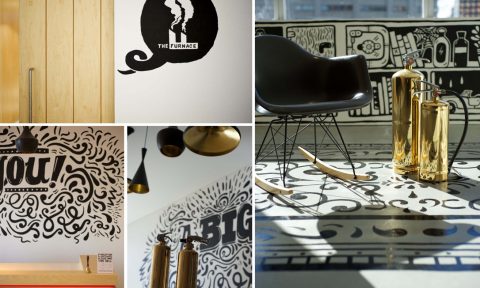
Photos: (Top) Dana’s work at The Furnace ad agency and (below) her studio, where the yellowtrace magic happens.
Win an award winning Dutch designer chair The Flux chair from Holland can hold up to 160kgs but it f
Win an award winning Dutch designer chair
The Flux chair from Holland can hold up to 160kgs but it folds up flat and can even be hung on the wall if storage is tight. It was awarded Grand Designs Product of the Year 2011 in the UK earlier this year and it is available in 8 bright colours. The Flux combines design with the benefits of foldable furniture: easy to carry, easy to store. Perfect if you love design and treasure your space.
Interiors Addict has one white Flux to give away worth $250. All you have to do is go to our Facebook page and tell us how and where you’d use it. One winner will be picked on Friday 30 September 2011.
Prop Hire Online launches ‘Find An Assistant’
Jenni Booth, stylist and creator of Prop Hire Online, says: “One of the questions I get asked most by other stylists is “Can you recommend a good assistant?”
“I probably get asked this at least once a week. Finding a good assistant that you can trust to do a good job is hard it seems. There is no one directory or listing out there of assistant stylists… until now!”
Jenni’s adding a new category to Prop Hire Online called Find an Assistant. It will be a directory of stylist assistants in each Australian city with their experience and contact details. To ensure a high standard of service, when signing up, each assistant will be given an extensive list of guidelines of what is expected of them while assisting on a photoshoot, the do’s, don’ts and nevers!
All stylist assistants and stylist wannabes should email info@prophireonline.com.au for info. What are you waiting for?
Dana Tomic Hughes, the designer behind the yellowtrace blog
Interior designer and blogger Dana Tomic Hughes takes a holistic approach to design with a style which is eclectic and “high on personality”.
Dana was Associate Director of Interiors at Bates Smart before going out on her own with her company yellowtrace in 2008, later starting the successful blog of the same name.
“During my time at Bates Smart I was responsible for some of the most wonderful projects varying in scale and complexity – from quirky advertising agencies and residential interiors, to one of the biggest and most prestigious fitouts in the country for Sydney’s largest law firm,” she says. In June this year, Dana decided it was time to take the plunge and focus on yellowtrace full-time. “With my strong conceptual design focus, relentless desire to push boundaries and challenge the conventional, I was keen to share my passion for design and conceptual thinking with both clients and collaborators. yellowtrace allows me to do this on a more personal level with my clients, which is how I really like to work.”
Dana says: “My design philosophy is based on a holistic approach, which translates brands, ideas and my clients’ personalities, into places. Each project begins with a strong concept, which becomes an anchor for all ideas during the design process.” She collaborates with a network of freelancers to assemble the best team for any job.
So, what’s in the name? ”Yellowtrace is a soft tone transparent sketch paper used by architects and designers for concept drawings and sketches. I go through kilometres of yellowtrace when starting any project – it is where most of my ideas and concepts are born before they are developed into final designs and built forms. I thought this was a really nice link between my design process and a name for a design practice and a design blog.”
The blog started at the beginning of last year. “As a designer, I’ve always been a bit of a visual junky,” says Dana. “As most designers are, I am a highly visual person who is really inspired by beautiful imagery. I started collecting images of interior spaces and interior products many years ago as I discovered that they really helped me with my design process. They are also a fantastic way to communicate my ideas to clients.
“At first I had a small number of images I used to turn to regularly, but very quickly I realised that I needed a broader point of reference, as any good designer draws inspiration from anything and everything. My constant search for inspiration and images grew my library of information and I got hungrier and hungrier the more I uncovered. So you see I needed an online space where I could catalogue and share all of this research.”
Dana’s also interested in how other designers approach their work and she felt there weren’t enough local blogs and forums written by designers that focused on both Australian and international talent. “Design can be a solitary activity, although its success relies heavily on healthy critique, discussion, and input of others,” she says. “I’ve often felt that designers, architects and creative people don’t always share what they are doing, and we can also be very critical of each other’s work. I wanted to create a space where great work can be celebrated and where other designers could gain invaluable insight into the processes of their peers through regular interviews. At the same time, I’m keen to educate readers about the importance of well thought out and inspiring design, and also make good design accessible to not just design professionals, but also the general public – all with a healthy dose of humour.”
Dana describes her personal interior style as eclectic and high in personality. “Our home is comfortable, unpretentious and inviting with a real of mix pieces from different eras – vintage to modern, designer to junk, achieving an overall sense of unique character and carefully considered balance.
“Our apartment is a constant work in progress and it very much responds to the way Husband and I live, who we are as individuals and as a couple. White walls, high ornate ceilings, well designed furniture, pure and clean forms allow us to layer in bold patterns and collected objects which add an element of fun and personality, and evoke memories of travel and the everyday.”
In part 2 tomorrow, more on the success of the blog, the best and worst bits of being an interior designer, who Dana admires and what makes a good designer.