Updating an existing house rather than replacing it was one of the trends judges spotted in this year’s Houses Awards shortlist. A more sustainable approach to design, many homes are innovative re-workings of existing dwellings rather than knock-down rebuilds. Homes that are under-appreciated forms of architecture or have heritage overlays have been lovingly upgraded to better prepare them for modern use.
Here, we look at four homes in the shortlist that fall under this trend.
Crescent House by Studio Bright
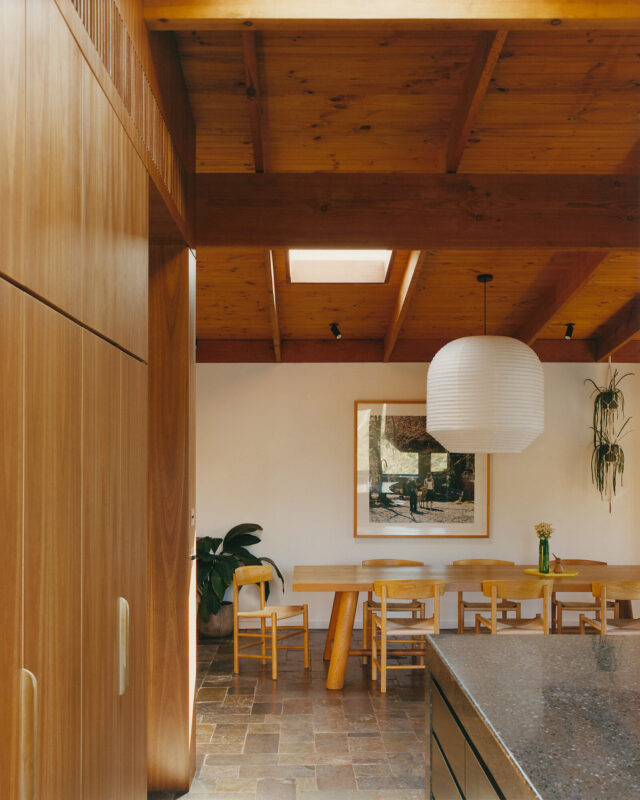
Crescent House is a surgical adaptation of a 1970s beach home on a bush-edged Mornington Peninsula site. The original spatial framework of the house is retained, and a unifying external veil shaped by three crescent geometries consolidates old and new elements, reinforcing the home’s relationship to its coastal landscape.
“Crescent House is the careful adaptation of a 1970s beach home on a bush-edged site on the Mornington Peninsula, supporting a family’s transition from city living to a permanent coastal home. The clients were strongly drawn to the character of the original house, particularly the generous tri-spatial living areas organised around a masonry double-sided fireplace. Rather than replace the house, the project adopts an intricate surgical approach, retaining key spatial qualities while selectively removing a series of ad hoc additions that had compromised both function and clarity.
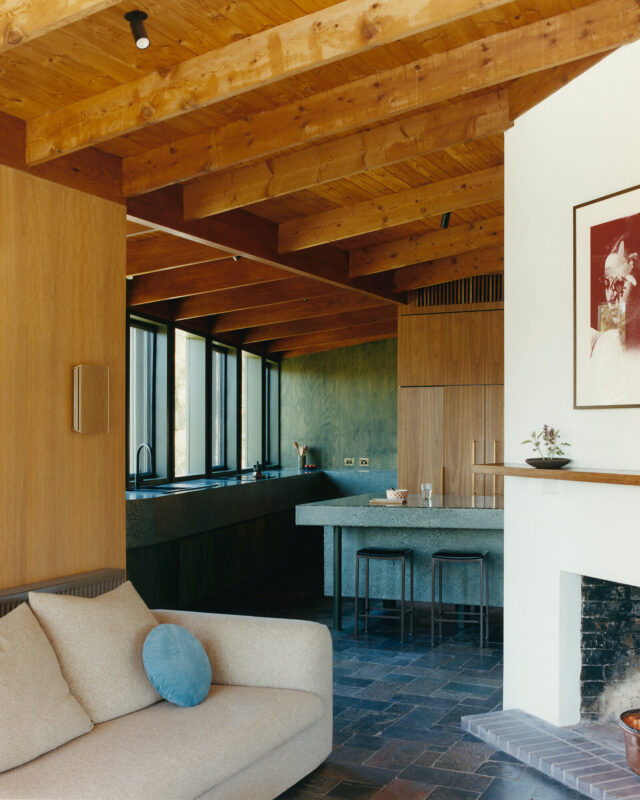
A unifying external veil brings coherence to retained and new elements. Formed from a simple timber post structure shaped by three subtle crescent geometries, the veil establishes a legible architectural language while mediating light, outlook and privacy. Timber posts land on a custom-formed green concrete plinth, responding to both flooding and bushfire considerations.
The entry sequence is reconfigured through a new boardwalk that navigates the sloping landscape, replacing an awkward arrival via a former carport and bringing visitors directly into the heart of the house. The new volume extends toward the bay to create an elevated outdoor deck among the trees, while bedrooms and family spaces below are partially embedded into the landscape, strengthening the relationship between house and garden.
Existing materials, including slate floors, timber ceilings and roof structure, were carefully repaired and retained. New interventions remain legible through subtle shifts in form, material orientation and detail, reinforcing the project’s careful balance between continuity and change.”
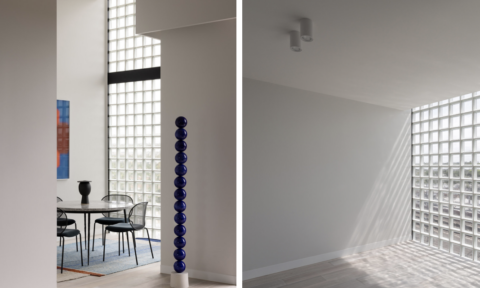
North Melbourne Apartment by Card Practice
An apartment renovation which prioritises small furniture interventions and creative reuse over extensive demolition, in a double brick 1960s walk-up apartment building. The design enhances functionality, clarity, and liveability, without increasing the apartment’s footprint.
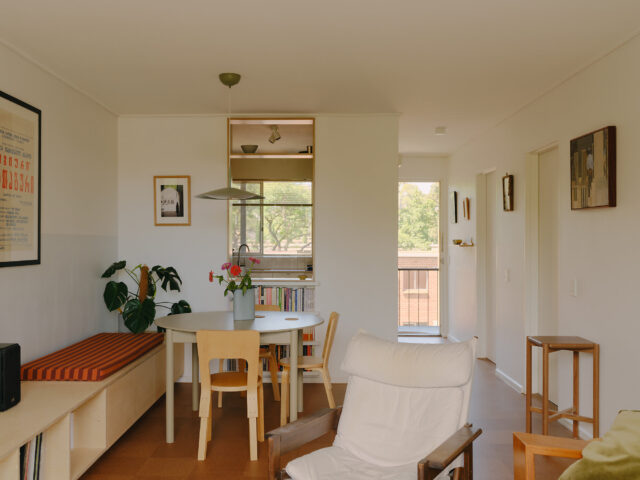
Located within a modest double-brick walk-up, this project demonstrates an approach that can be readily applied to many of Melbourne’s apartment buildings. Rather than relying on extensive demolition, the strategy prioritises precise, low-impact interventions that significantly improve spatial quality and liveability. This reflects a broader shift toward working with what already exists, enhancing everyday environments through thoughtful design.
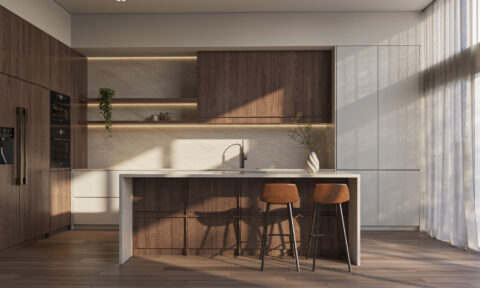
Central to the refurbishment is a reconfigured kitchen that opens sight lines through the apartment, drawing the eye toward surrounding landscape views while forming a defined ‘room within a room’. A carefully framed servery reinforces this idea, operating as an internal window that visually connects adjacent spaces without compromising the compact floor plan.
Storage and seating are consolidated into a continuous piece of joinery that runs along the living area. This element accommodates books, records, and personal objects, while also creating a dedicated dining nook. By integrating multiple functions into one gesture, the design reduces the need for additional furniture, allowing the apartment to feel more generous and cohesive.
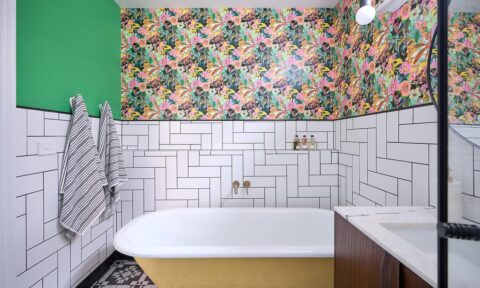
The bathroom renovation follows a similar philosophy of restraint and everyday use, focusing on improving functionality while maintaining a calm, pared-back aesthetic. A laundry is carefully integrated within the bathroom vanity, paired with finishes and fixtures that aim to maximise the compact footprint.
Material selection plays an equally important role throughout. A new cork floor introduces warmth and texture underfoot, unifying the kitchen and living areas while subtly distinguishing their functions. The restrained palette and tactile surfaces create a cohesive interior that enhances comfort and everyday living.”
Borland Crossman House by Wowowa Architecture
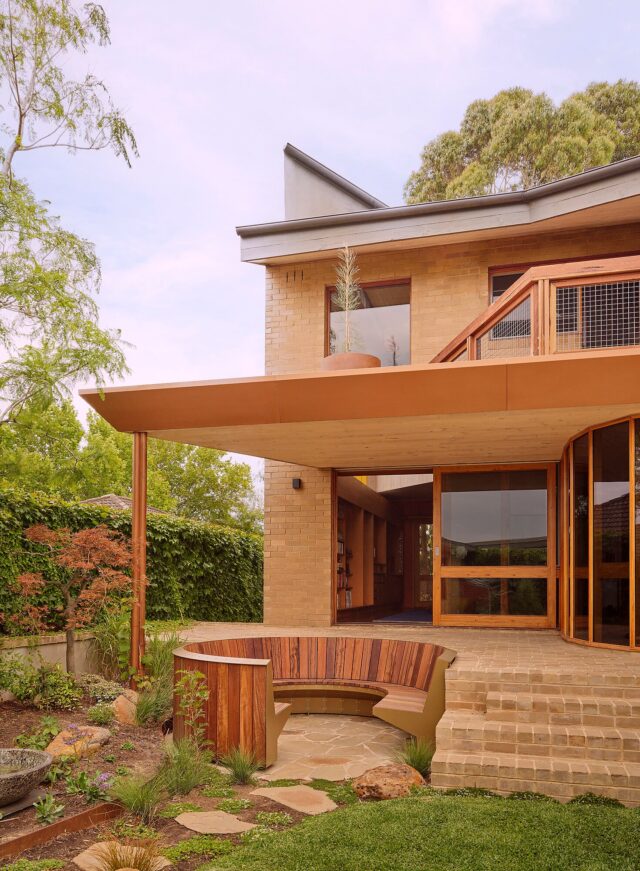
First published in Belle Magazine (1978), Borland Crossman House is a restoration and adaptive reimagining of a Kevin Borland modernist gem in Glen Iris. WOWOWA carefully disassembled the elements that no longer served a contemporary family, stitching them back in a way that feels both fresh and deeply respectful.
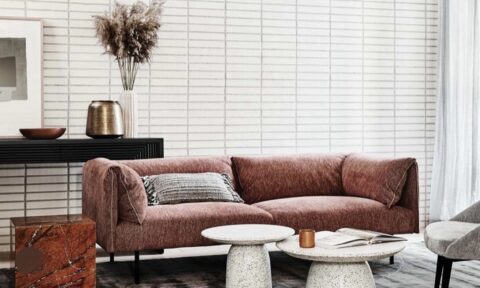
“Adorned in vibrant primary colours, this renovation to a 1970’s ‘nuts and berries’ rustic and decidedly Australian semi-brutalist brick and timber project is an exemplar of heritage and sustainability. The repair project beautifully balances technical carbon reductive rigor with architectural whimsy, honouring the robust legacy of Australian architecture while ensuring the home thrives for another generation.
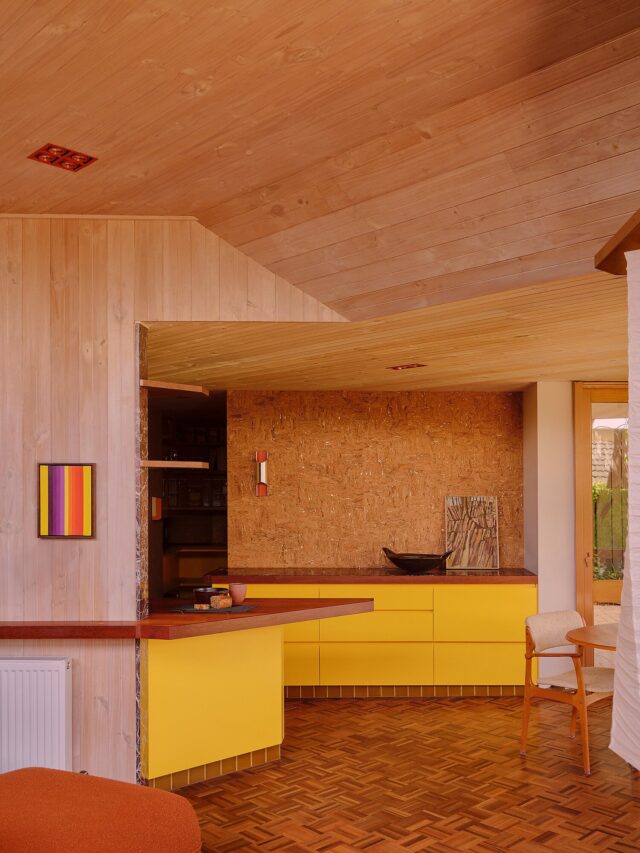
The design centres on the iconic double-height, fern-filled internal garden atrium, which is shielded by an east-facing slatted shade structure. Acting as custodians, the clients prioritized circularity, opting for painstaking restoration over replacement. This commitment is visible in the precise spatial interventions; for instance, a faceted half-circle window suite was shifted 800mm to accommodate an eight-person dining table. A delicious array of colors—primary red, yellow, and Blue—is accompanied by dusty mustard, mission brown, and a gorgeous crane wallpaper, nodding to the Robin Boyd Japanese era that facilitated a uniquely Australian fusion to the Melbourne modernist paradigm.
The study serves as the hero of the project. Formerly a mechanical room, it now features a crafted coved joinery desk and a matching facade curtain wall that provides new sightlines through the void to the revitalized internal garden. With extraordinary care, existing timber linings were removed, sorted, repaired, and reinstalled alongside new boards color-matched through a replicated whitewash oil process—completed by the clients themselves. Like treasure, the taps, basins, lights, knobs, and tiles were retained and embellished alongside a taxonomy of precious original details.”
Ernest House by Brighton by Bower Architecture & Interiors
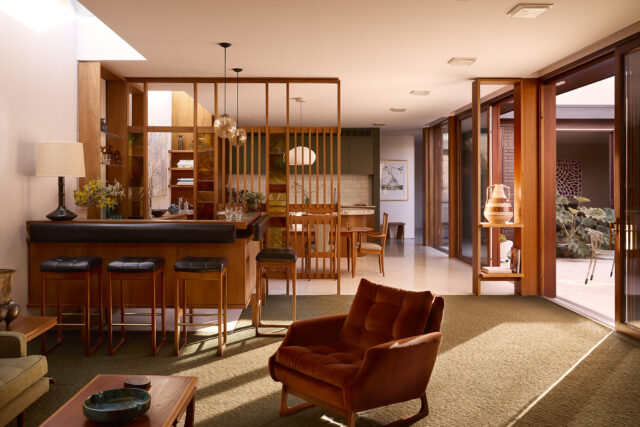
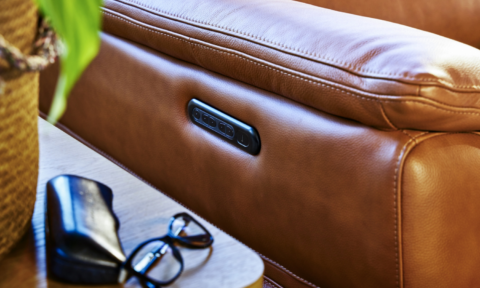
A renovation and restoration of a 1968 Harry Ernest & Associates designed Mid Century single level villa to create a comfortable, light and warm forever home for the clients’ retirement.
“The brief called for a home that is comfortable, light and warm—modern and open, yet unpretentious and quietly joyful. Designed for a pair of homebodies, it supports daily rituals of reading, music and slow mornings, with sunlight, garden outlooks and spaces that feel both easy and welcoming. A love of art, cooking and entertaining is woven throughout, with moments of surprise and delight.
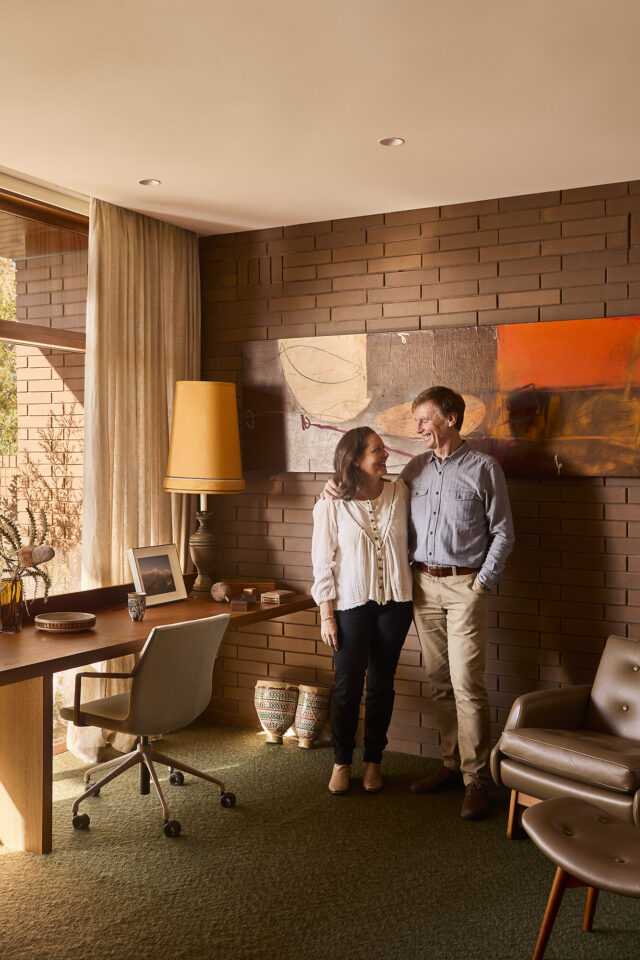
The architectural response is deliberately restrained: to retain and restore the original house, with interventions limited to precise internal rearrangements, new high-performance double glazing, carefully placed windows and doors to strengthen garden connections, and skylights to draw daylight deep into the plan. Material upgrades improve durability and comfort, with enhanced insulation and a fully electric system—including heating, cooling and hot water—supported by a substantial solar array, achieving a 6-star outcome.
A conversation with the original architect, Harry Ernest, reaffirmed the value of the home’s defining qualities: its brown brickwork in Flemish bond, low-slung street presence and courtyard focus. The light-touch approach honours this legacy while enabling a renewed and enduring life.”
The winners of the 2026 Houses Awards will be announced at a gala event on Friday 4 September, with projects awarded across nine categories. One winner is awarded the premier title of Australian House of the Year. Each award category offers a $1,000 cash prize, and the winner of the Australian House of the Year will receive a $5,000 cash prize.
After the awards ceremony, the eventual winners and commendations will be announced online on Saturday 5 September 2026, across Architecture Media’s online platforms. A gallery of the shortlisted homes is also on the Houses Awards website.